Bambino Plus vs Barista Express: Which Breville for Decaf?
As an Amazon Associate I earn from qualifying purchases.
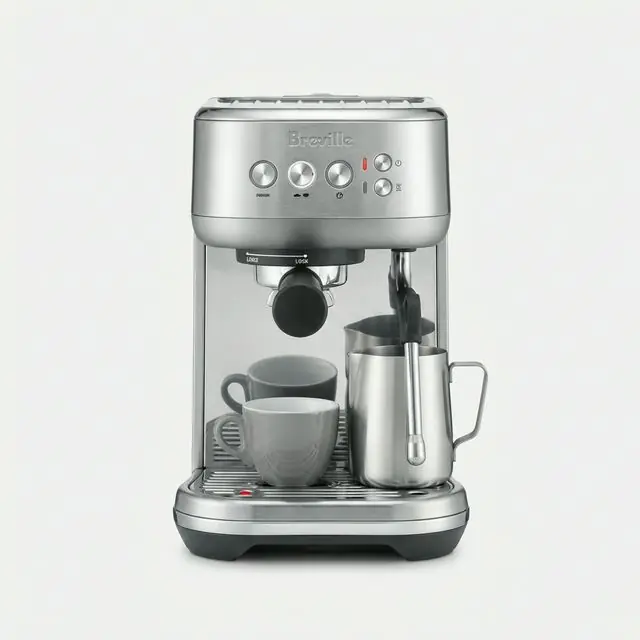
These are the two Breville machines most people choose between, and almost every comparison frames it the same way: the Barista Express includes a grinder, so it is better value. That framing is fine if you drink one kind of coffee.
If you drink decaf — especially if you also drink caffeinated — the built-in grinder flips from an asset to a daily annoyance. That is the argument nobody makes, and it is the one that should decide this for you.
Head to head
| Category | Bambino Plus | Barista Express |
|---|---|---|
| Built-in grinder | No | Yes, conical burr with hopper |
| Heat-up time | ~3 seconds (ThermoJet) | ~30 seconds (thermocoil) |
| Portafilter | 54mm | 54mm |
| Milk system | Automatic, temp + texture set | Manual steam wand |
| Water tank | 64 oz | 67 oz |
| Footprint | Very compact | Large |
| Pre-infusion | Low-pressure, automatic | Low-pressure, automatic |
| Best for | Pairing with your own grinder | One-box all-in-one |
Bambino Plus vs Barista Express: Which Breville for Decaf?
Check Price on AmazonAs an Amazon Associate I earn from qualifying purchases.
The grinder question is the whole comparison
As an Amazon Associate I earn from qualifying purchases.
Everything else here is a matter of degree. This one is a fork.
The Barista Express has a conical burr grinder with a hopper on top. You fill the hopper, and it grinds directly into the portafilter. That is genuinely convenient — one appliance, one workflow, no second purchase.
The problem arrives the moment you own two kinds of beans.
To switch from caffeinated to decaf you have to empty the hopper, run the grinder to clear the burr chamber and chute, and then accept that the first shot after the switch still carries retained grounds from the previous bean. A hopper grinder typically holds several grams in the path between burrs and portafilter. It never fully empties.
For most people that is a mild irritation. For someone drinking decaf because caffeine causes them a problem — sleep, anxiety, blood pressure, pregnancy, a medication interaction — retained caffeinated grounds in an evening shot is not a rounding error. It is the specific thing they were trying to avoid.
The Bambino Plus sidesteps this entirely by not having a grinder. You pair it with a single-dose grinder, weigh exactly the beans you want, grind them all, and nothing meaningful stays behind. Switching bean types takes zero extra steps.
That is not a small win dressed up as a big one. If you alternate daily, it is the difference between a workflow you enjoy and one you resent.
Speed and thermal behavior
The Bambino Plus uses Breville's ThermoJet system and is ready to brew in about three seconds from cold. The Barista Express uses a thermocoil and takes roughly 30 seconds, which is still fast but not instant.
More important than the headline number is recovery between shot and steam. The Bambino recovers faster, which matters if you are making two milk drinks back to back.
For decaf specifically, thermal stability earns its keep. Decaf tolerates a narrower brew temperature window before it goes papery, so a machine that holds temperature consistently shot to shot is doing real work. Both machines manage this competently; the Bambino is slightly better.
Shot quality
Both use a 54mm basket and a very similar brew group with automatic low-pressure pre-infusion. Fed identical grounds, they produce near-identical espresso.
We say that plainly because a lot of comparisons imply otherwise. Any difference you taste between these two machines comes from the grinder, not the brew head. If you put the Barista Express's built-in conical grinder against a good single-dose flat burr grinder feeding a Bambino, the Bambino wins on shot quality — but that is a grinder comparison wearing a machine comparison's clothes.
The 54mm basket produces a deeper puck than a commercial 58mm, which is marginally more channel-prone. That matters more on decaf, where the puck is already fragile. A precision basket is a worthwhile upgrade on either machine.
Winner: Tie on the machine. Bambino Plus if you invest the savings in a better grinder.
Milk
The Bambino Plus has an automatic steam wand. You set milk temperature and foam level, press the button, and it stops on its own. The output is consistently good enough for basic latte art with no skill required.
The Barista Express has a manual wand. Higher ceiling if you learn to use it, worse results for your first few weeks, and it demands attention every single time.
If milk drinks are most of what you make, this is a real gap and the Bambino wins clearly. If you mostly drink straight shots, it barely registers.
Winner: Bambino Plus.
Footprint and counter reality
The Bambino Plus is genuinely small — it fits under most cabinets and takes a fraction of the counter space. The Barista Express is a large appliance and looks it.
But compare fairly. A Bambino Plus plus a separate grinder occupies more total counter than a Barista Express alone. If counter space is your binding constraint, the all-in-one wins on absolute footprint.
Winner: Barista Express on total footprint, Bambino Plus on single-unit size.
Total cost, honestly
The Barista Express is more expensive than the Bambino Plus, but it includes a grinder. A Bambino plus a decent grinder generally costs more than a Barista Express — sometimes considerably more.
So the Barista Express is the better value at its price point, and the Bambino path is the better setup at a higher total spend. Anyone telling you one is simply cheaper is comparing different things.
Where the Bambino path wins on value is upgrade order. If you buy a Bambino Plus and a good grinder, you can later upgrade the machine and keep the grinder — which is the component that actually determines shot quality. Buy a Barista Express and the grinder is welded to the machine's fate.
Which one to buy
Buy the Barista Express if:
- You drink one type of bean and are not planning to switch
- You want a single appliance and one purchase
- Counter space is tight and you want everything in one box
- You are entering espresso from scratch with a fixed budget
Buy the Bambino Plus if:
- You alternate between decaf and caffeinated beans
- You already own a grinder, or plan to buy a good one
- Milk drinks are most of what you make
- You want an upgrade path that preserves your investment
For a decaf-focused setup specifically, we recommend the Bambino Plus paired with a single-dose grinder. See our best espresso machine for decaf guide for the full reasoning, and best espresso grinders under $500 for the pairing.
As an Amazon Associate I earn from qualifying purchases. Buying through this link costs you nothing extra.
Full individual reviews: Breville Bambino Plus and Breville Barista Express. If you are also considering a 58mm machine, read Bambino Plus vs Gaggia Classic Pro.
Frequently Asked Questions
Is the Barista Express better than the Bambino Plus?
It is more complete, not strictly better. The Barista Express includes a conical burr grinder, a dose-controlled workflow, and a larger water tank. The Bambino Plus has faster heat-up, a better automatic steam wand, and a much smaller footprint. If you already own a grinder, the Bambino Plus is the better machine of the two.
Can you use the Barista Express for decaf and regular beans?
Yes, but with friction. The integrated grinder has a hopper, so switching bean types means emptying it, purging the burr chamber, and accepting retained grounds in the first shot after a switch. If you alternate daily, a Bambino Plus paired with a single-dose grinder is a cleaner setup.
Do the Bambino Plus and Barista Express make the same espresso?
The brew group and 54mm basket are effectively equivalent, so with the same grounds they produce very similar shots. The Bambino Plus has slightly faster thermal recovery. Any real difference in the cup comes from the grinder feeding them, not the machines themselves.
Which is better for milk drinks?
The Bambino Plus. Its automatic steam wand hits a set temperature and texture reliably enough for basic latte art with no technique. The Barista Express uses a manual wand, which has a higher ceiling if you learn it but produces worse milk for the first few weeks.
Best Decaf Espresso Editorial Team
Research-based reviewsWe research every machine, grinder and bean from manufacturer specs, manuals and long-term owner reports, and we read them with decaf in mind. We don't run in-house tests.
You Might Also Like
Breville Bambino Plus Review (2026): The Best Small Machine for Decaf Espresso?
A decaf-first look at the compact Breville Bambino Plus: why the 3-second heat-up makes it the best small espresso machine for evening decaf drinkers.
Read More
Breville Bambino Decaf Settings: Dose, Grind & Shot Guide
The dose, grind, and shot settings to start from for sweet decaf espresso on the Breville Bambino Plus, plus a step-by-step dial-in walkthrough.
Read MoreBambino Plus vs Gaggia Classic Pro
Two of the most popular starter machines compared head-to-head. Which is better for your first espresso setup: the Bambino Plus or the Gaggia Classic Pro?
Read MoreEnjoyed this article?
Follow us for more practical espresso and decaf insights delivered to your inbox.