Breville Barista Express Review (2026)
As an Amazon Associate I earn from qualifying purchases.
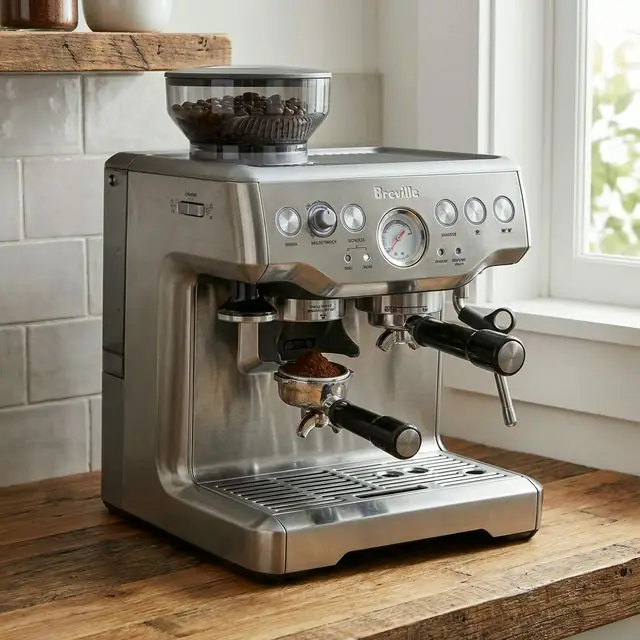
The Breville Barista Express (BES870XL) is the machine that launched a thousand home cafes. It's the all-in-one standard: grinder, machine, and tamper in one package. After more than a decade on the market, it still outsells nearly every semi-automatic in its price range — and for good reason.
Key Features
- Analog Pressure Gauge: Helps you dial in your grind by showing you exactly what's happening during extraction.
- Thermocoil Heating: Fast heating, though not as instant as the newer ThermoJet models.
- Dose Control Grinding: Integrated conical burrs dose directly into the handle.
- Manual Steam Wand: A single-hole wand that takes time but gives total control.
- 2L Water Tank: Generous capacity that lasts several days for most households.
Performance
Brewing
The Express is capable of fantastic shots. The PID keeps temp stable. The biggest learning curve is the grinder — it has large steps between settings, which can sometimes make dialling in tricky.
Let me expand on that, because the grinder is both the Express's biggest selling point and its most debated feature.
The Integrated Grinder: A Closer Look
The built-in conical burr grinder has 18 macro grind settings with an inner adjustment ring for micro fine-tuning. On paper, that sounds like plenty. In practice, the macro steps are noticeably large — sometimes one click is the difference between a gushing 15-second shot and a choking 45-second one. The inner ring helps bridge that gap, but it's fiddly and most beginners don't discover it for months.
The burrs are 54mm stainless steel conical burrs. They produce a grind that's consistent enough for excellent espresso but noticeably less uniform than a dedicated grinder like the Breville Smart Grinder Pro or a Eureka Mignon. You'll see slightly more fines, which can contribute to occasional channeling if your puck prep isn't solid.
Grind retention sits at about 1-2 grams, meaning some old grounds carry over between sessions. For daily drinkers using the same beans, this is a non-issue. But if you switch between different beans frequently, you'll want to purge a dose when swapping.
Dose Control and Workflow
The grinding workflow is intuitive: lock your portafilter into the cradle, press the grind button, and the machine doses directly into the basket. The dose control dial lets you adjust how much coffee it grinds — factory default is about 18g for a double, which is a good starting point. The included razor dose trimming tool scrapes off excess grounds for a level bed, though many users ditch it in favor of WDT (Weiss Distribution Technique) tools once they get serious.
A typical shot workflow takes about 90 seconds from start to finish: grind, distribute, tamp, lock in, pull. That's faster than a separate grinder-and-machine setup where you're transferring grounds between devices, and it's a big part of why this machine is so popular for busy mornings.
Steaming
The steam power is slower than the Bambino Plus or Barista Pro, but it produces very dry steam. It's excellent for learning texturing because the slower pace gives you time to react. The single-hole tip means you need to position carefully to create proper vortex rotation in the milk jug. Once you find the sweet spot, the results are genuinely cafe-quality — silky, glossy microfoam with tight bubbles. Budget 30-40 seconds for a full 12oz latte pitcher.
Barista Express vs. Separate Grinder + Machine
This is the question I get asked most. Would you be better off buying a dedicated grinder (say, a Eureka Mignon Notte for $250) and a simpler machine (like the Bambino at $300)?
Honestly, the separate setup will produce marginally better espresso. A dedicated grinder gives you finer step adjustments, lower retention, and more consistent particle distribution. But the combined cost is $550+ before you add a tamper, scale, and accessories — and you're now managing two devices, two footprints on your counter, and two maintenance schedules.
The Express bundles everything into one cohesive package for around $600-$700 (depending on sales), and the convenience factor is real. For most home users who aren't obsessing over extraction charts, the Express delivers 90% of the quality at significantly less hassle.
The Barista Express Impress Upgrade
Breville released the Barista Express Impress (BES876) as a successor, and it addresses the Express's biggest weakness: tamping consistency. The Impress has an assisted tamping system built into the portafilter cradle that applies calibrated pressure automatically. It also features the ThermoJet heating system (3 second heat-up vs. the Express's 30+ seconds) and a slightly updated grinder.
If you're buying new today and the Impress is within budget (usually $100-$150 more), it's the better buy. The assisted tamping alone removes a major variable from the beginner learning curve. But if you find an Express on sale or refurbished, it's still a fantastic machine — the manual tamping just requires a bit more practice to get right.
Longevity and Reliability
The Barista Express has one of the best track records in home espresso. Machines routinely last 5-8 years with basic maintenance (regular backflushing, descaling every 2-3 months, and occasional gasket replacement). The solenoid valve is the most common failure point on older units, typically around the 4-5 year mark, and it's a $30 part that a handy person can replace at home.
Breville's customer support is also above average for the appliance industry. They stock replacement parts for years after a model's release and their phone support can actually walk you through troubleshooting.
Verdict
In 2026, it faces stiff competition from its own siblings (Barista Pro, Barista Touch, and the Impress). However, strictly for the feeling of manual control and the beautiful analog gauge aesthetics, it remains a top pick. It's the best machine to learn on.
The Express teaches you every fundamental — grinding, dosing, tamping, pulling, steaming — without hiding anything behind automation. When you eventually upgrade (and you probably will, because this hobby is a slippery slope), you'll carry those skills with you. No other machine in this price range offers that combination of built-in grinder convenience and hands-on learning opportunity.
It's not perfect. The grinder steps are too coarse, the heat-up time feels slow by modern standards, and the steam power won't win any races. But as a complete package for someone entering the semi-automatic world, nothing else matches its balance of capability, education, and value.
Rating: 4.7/5
As an Amazon Associate I earn from qualifying purchases. Buying through this link costs you nothing extra.
Barista Ben
Home Espresso EnthusiastBen has been pulling shots at home for over eight years, starting with a Gaggia Classic and working up to dual boilers. He focuses on practical, real-world advice for home baristas who want cafe-quality results without cafe-level budgets.
You Might Also Like
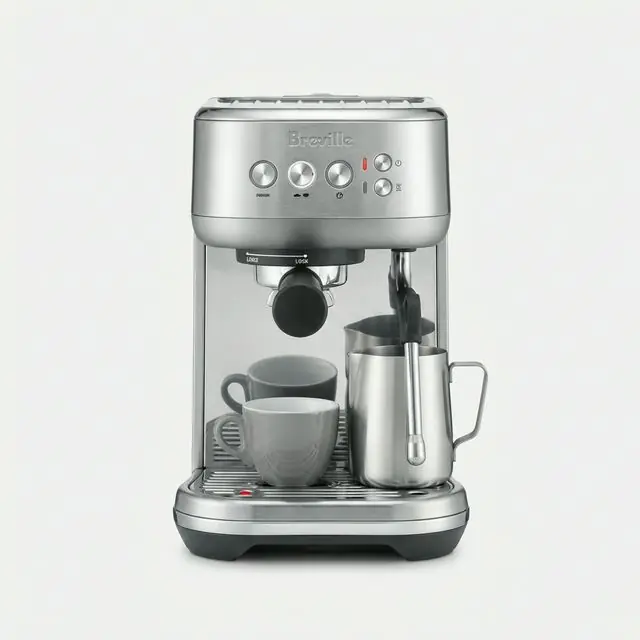
Breville Bambino Plus Review (2026): The Best Small Machine for Decaf Espresso?
A decaf-first look at the compact Breville Bambino Plus: why the 3-second heat-up makes it the best small espresso machine for evening decaf drinkers.
Read More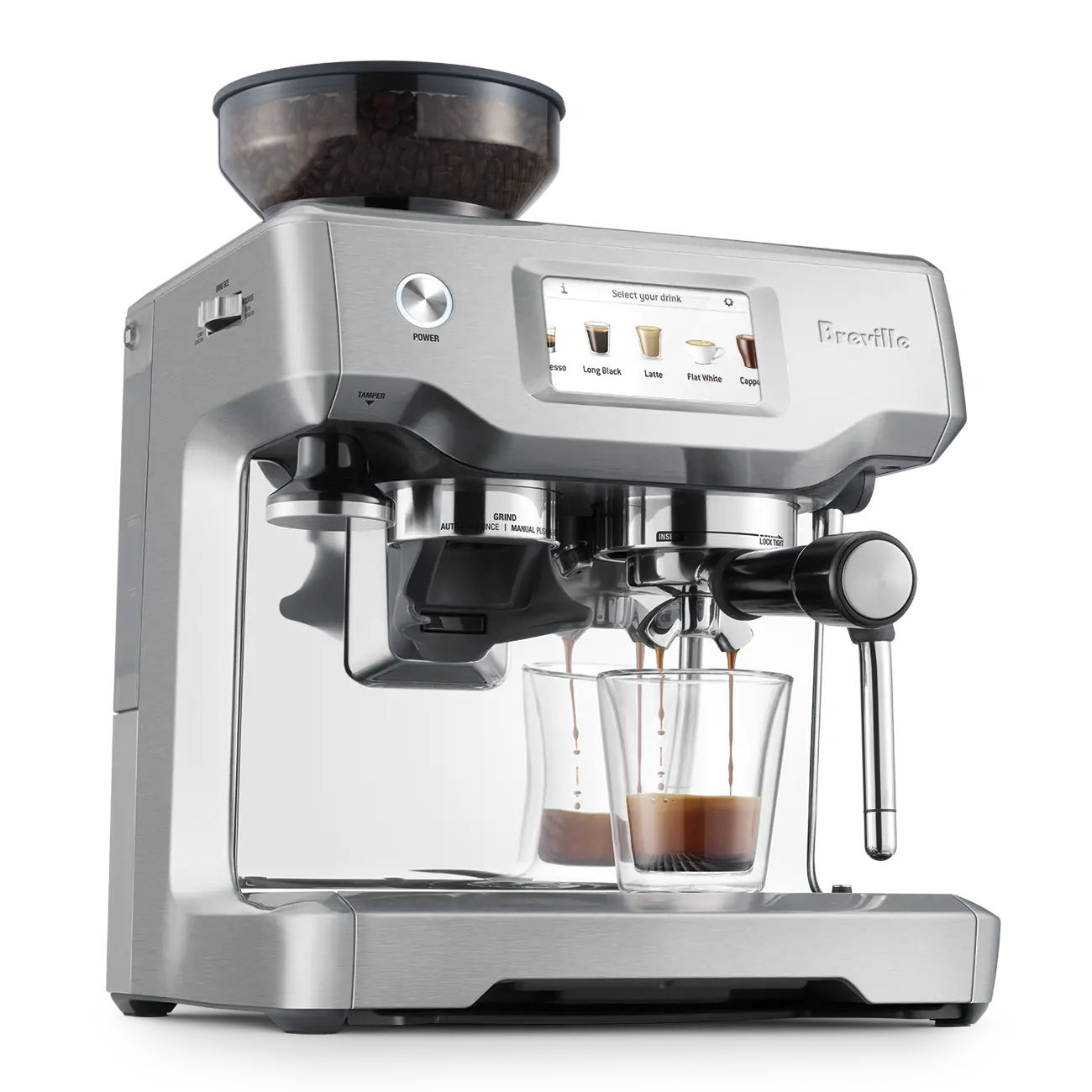
Breville Barista Touch Review (2026)
Our Breville Barista Touch (BES880BSS) review: touchscreen workflow, ThermoJet speed, and whether the premium price is worth it for home baristas.
Read MoreBambino Plus vs Barista Express: Which Breville for Decaf?
The Barista Express bundles a grinder. That is its biggest selling point and, if you drink decaf and regular, its biggest liability. Here is the honest comparison.
Read MoreEnjoyed this article?
Follow us for more practical espresso and decaf insights delivered to your inbox.